The Egg Bandits Made a Thousand Times the Fine They Just Paid for Price Fixing
Mirrored from Hacker News — AI on Front Page for archival readability. Support the source by reading on the original site.
Crime Pays: The Egg Bandits Made A Thousand Times the Fine They Just Paid for Price Fixing
The Stringer Bell rule is obsolete, as Trump let big egg producers off the hook for what looks like a brazen multi-year conspiracy. Still, egg prices did drop as a result of the investigation.
A few days ago, 18 states and the DOJ Antitrust Division signed a series of decrees with three major egg producers, Cal-Maine, Versova, and Hickman’s Egg Ranch, the largest egg producers in the country. The allegation, backed with hard-to-refute evidence including quotes from CEOs, is these entities operated a naked conspiracy to manipulate the price of eggs from 2022-2025. That was exactly the time bird flu on poultry farms was ripping through the supply chain for egg production.
Readers of this site won’t be surprised at this news. Last year, BIG published an investigative series called Hatching a Conspiracy, in which Basel Musharbash discussed what looked like a conspiracy. His argument was that egg producers were using the avian flu crisis as a veil to raise prices. Basically, consolidation had created concentrated power, and the shock of the flu let them exploit it. He highlighted the role of Cal-Maine, the industry’s “bellwether,” as well as the history of antitrust violations in the industry.
While most normal people at the time thought someone was likely scamming them, that is not the message you heard from the industry, elite media, or economists. Throughout the alleged conspiracy, industry executives and analysts were saying that there was nothing to see except a supply shock of a disease killing lots of hens. As one industry executive put it at the time, it’s all just “supply disruption, ‘act of God’ type stuff.”
Economists chortled at the notion of a conspiracy. During the 2024 campaign, when Kamala Harris meekly suggested price gouging to tame inflation, she ran into a buzzsaw of resistance from Democratic-leaning economists, who were openly sneering at her in the New York Times.
“Egg prices went up last year — it’s because there weren’t as many eggs, and it caused more egg production,” said Jason Furman, a Harvard economist formerly in the Obama administration…
Mr. Furman said there was a risk that policies meant to curb corporate price gouging could instead keep the economy from adjusting. If prices do not rise in response to strong demand, new companies may not have as much inclination to jump into the market to ramp up supply.
“This is not sensible policy, and I think the biggest hope is that it ends up being a lot of rhetoric and no reality,” he said. “There’s no upside here, and there is some downside.”
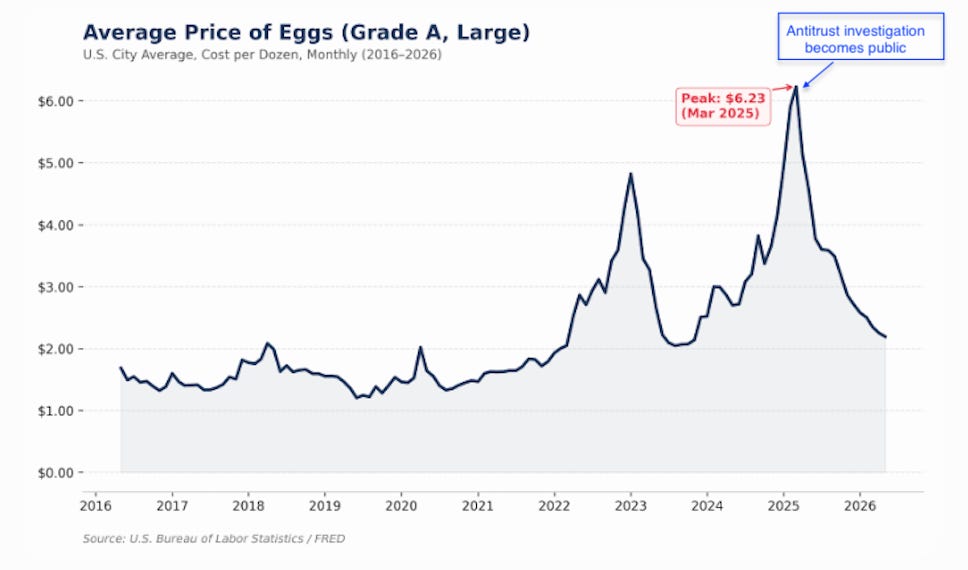
Price action seemed to confirm Furman’s view. In 2025, egg prices dropped dramatically, and then further this year, though they are still roughly 40% above where they were in 2019. And these price declines suggested that supply and demand were doing their magical work. Populists were mocked as ignoring natural market forces. Pundit Matt Yglesias called the theory of egg price manipulation “slopulism,” the Cato Institute blogged “Egg Prices Don’t Need to Be Investigated—It’s Just Supply and Demand, and here’s philanthropist John Arnold.


But lo and behold, this complaint has stone cold evidence. It includes many statements from egg producer CEOs emailing and texting one another on how to manipulate prices upward. And it turns out, when they felt threatened by legal action, the alleged price-fixing stopped. Suddenly, the avian flu epidemic was no longer pushing up prices.
To understand what they were doing, we have to start with how egg prices are set.
Egg producers don’t sell eggs to consumers, they sell wholesale to supermarkets, packaged goods companies, restaurants, and so forth. There are two markets for wholesale eggs. Most go via contracts between egg producers and big buyers. For instance, roughly 28% of Cal-Maine’s production is sold to Walmart, through a special supply arrangement. But there’s also an electronic exchange, called the Egg Clearinghouse, for eggs sold in the spot market, aka extra eggs. Egg producers are usually net sellers of eggs, but they have contracts to provide eggs, and sometimes can’t fulfill those contracts through their own production. Other egg producers might have extra eggs. So there is buying and selling of surplus eggs on the Egg Clearinghouse.
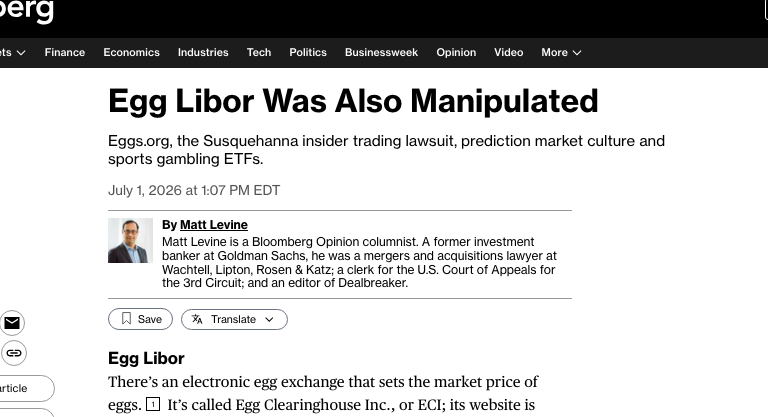
As Bloomberg’s Matthew Levine puts it, there’s a small market - the Egg Clearinghouse - and there’s the big market, which are the contracts between buyers and egg producers. Where do the prices for the private buyers and sellers come from? Well, they come from the Egg Clearinghouse. Specifically, a company called Urner Barry looks at prices for different regions based on trades and bids on and off that exchange, their analysts do as best they can to estimate prices across regions, and then they publish a price of where they imagine supply and demand intersect.
In other words, the cleared price in the small market sets the price for the big one. Here’s Cal-Maine’s annual report: “Many of our sales arrangements with customers, particularly for conventional eggs, are based on formulas that take into account, in varying ways, independently quoted regional wholesale market prices for eggs.” And it uses Urner Barry pricing charts.
And therein lies the alleged scam. If you can get Urner Barry to publish higher prices from the small number of eggs sold on the Egg Clearinghouse, then the price that, say, Walmart pays on its billions of eggs goes up.
Such benchmarks, as well as manipulation of them, are common. This egg index is similar to how a few banks used to set a key interest rate called LIBOR, the price of lending short-term funds to one another, and a benchmark for credit cards, commercial lending, and a whole host of credit products. The LIBOR price-fixing case dragged on for years, and is quite famous.
The alleged egg conspiracy itself was pretty simple. Evidence showed egg producers were colluding to trick Urner Barry into raising its published price. Here’s the Antitrust Division press release:
As the complaint alleges, Defendants conspired to inflate Urner Barry’s price quotations by agreeing to: (1) submit a large number of bids; (2) cause multiple Defendants to bid in order to signal to Urner Barry that a diverse set of market participants needed to buy eggs; (3) submit a large number of bids in the hours leading up to the publication of Urner Barry’s price quotations; (4) submit bids that were unlikely to lead to executed trades; and (5) execute trades at premium prices.
Producers were submitting fake bids, conducting sham transactions at high prices off the exchange, and coordinating to make it look like there was more demand than there was.
The most remarkable part of the complaint is one particular quote. At a certain point, Urner Barry was considering lowering is published price of eggs in response to a lack of demand. So one of the alleged conspirators wrote a fellow CEO, saying “[a]s a group we need to bid like they vote in Chicago, early and often.” In short, they should submit fake purchase orders at elevated prices, to convince the index to raise prices. In this case, it worked; Cal-Maine, Versova, and Hickman’s then collectively submitted dozens of bids, versus just five for the rest of the market. The price was then higher than it should have been.
What I like about that quote isn’t just that it’s evidence of collusion, it’s actually a joke premised on rigging the market the way machine politicians rig elections. These guys weren’t just allegedly price-fixing, they were having a lot of fun doing it. And they even violated the Stringer Bell rule, as this stuff was in email.
There’s a lot more evidence in the complaint, even though the complaint is pretty short (and it says the DOJ withheld a lot of evidence.) For instance:
After receiving Hickman’s CEO’s directive to “[b]id early and often,” on December 22, a senior Versova executive told another Versova executive to “light up the northwest bids please. .02 over.” That executive agreed and then placed bids at a price that was two cents greater than Urner Barry’s price quotation for the Northwest. Prospective sellers were required to call prior to accepting these bids. Then, when one of the Versova executives noted that the “NW bids are getting hit”—meaning that a seller was offering to sell the eggs to Versova to meet Versova’s bid—the other Versova executive stated that he should delete the bids, suggesting that Versova did not need the eggs.
Here are some other quotes:
"We are bidding up. Let's hold it today." – Text message from a Cal-Maine executive to Hickman's CEO on October 14, 2022.
"If we all bid in our respective areas for the 3-5 loads minimum we are short... the market reporters will have to address." – Email response from Hickman's CEO on December 19, 2022
"Please consider posting strong bids, early and often. The market reporters don't get in for another hour, so it will be good for them to see diverse bidding upon logging on." – Email from Hickman's CEO to senior executives from Cal-Maine, Versova, and others on December 20, 2022
"Hurry[.] There are only 16 bids on ECI right now and 15 of them are ours" – Email from Hickman's CEO later on December 20, 2022
"Finally!!!!" – Written reaction from the CEO of Cooperative A when forwarding Urner Barry price increase reports to Cal-Maine on August 9, 2023
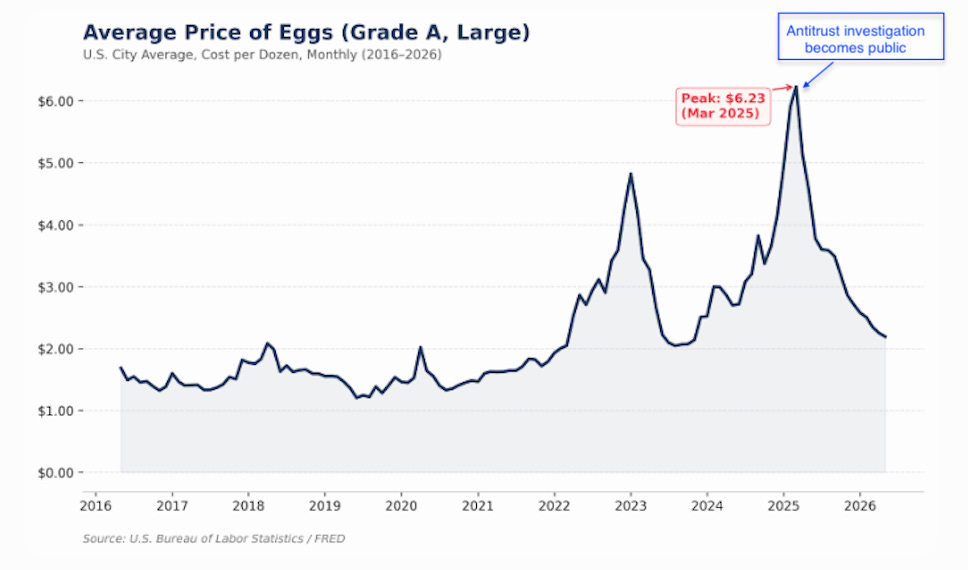
The alleged scam went on for years. Until the holiday season in 2024, the egg producers “continued to lobby Urner Barry,” asking the pricing index to hike its published prices and to ignore transactions at lower prices from non-conspirators when doing its benchmarking. So what finally ended the alleged conspiracy? It turns out that "price quotations dropped significantly from their February 2025 peak after Defendants learned of the Department of Justice investigation and were instructed to preserve documents on March 5, 2025.”
When egg producers realized they might get in trouble, they stopped the alleged scheme. Here’s a chart showing price action and antitrust.
Still, what a profitable conspiracy it was. Cal-Maine made more than $1 billion in profits in 2023, triple its 2022 earnings. And it made $1.8 billion in 2024, almost entirely as a result of higher prices As Musharbash put it:
All of this extra profit is coming from higher selling prices, which have been earning Cal-Maine unprecedented 70-145 percent margins over farm production costs per dozen. Taking Cal-Maine as the “bellwether” for the industry’s largest firms — as people in the egg business do — we can be pretty confident that the other large egg producers are also raking in profits off the relatively small dip in egg production.
Seeing the writing on the wall for egg prices, Cal-Maine has recently been using its cash haul to diversify into prepared foods in which eggs are an input, meaning while they still seek to sell eggs at high prices, they now have lines of business that benefit from lower prices as well.
Still, they all got caught. So how much trouble are they in? Well according to the settlement, the egg producers must pay in aggregate $3 million in penalties, must donate 53 million eggs to food banks, and can no longer fix prices. Cal-Maine was the ringleader here - it had to donate 30 million eggs, Versova gave 20 million, and Centrum donated 3 million.
Is that enough? Well, let’s start with a very basic concern. If you’re looking at some of these clear emails and texts and wondering why there’s no criminal charge for price-fixing, you’re not alone. Most antitrust lawyers I know are mocking this settlement as a farce, since it looks so obviously like criminal behavior but instead ended up with a no-admit/no-deny parking ticket. But let’s put that aside, and just look at the cost/benefit. Cal-Maine has to pay $1.5 million, let’s throw in another $1.5 million to cover the cost of the 30 million eggs they had to donate. That means they are out $3 million, for a scheme that netted them more than $3 billion. That’s a thousand-fold return.
Importantly, these firms also admitted no wrongdoing, meaning there can be no follow-on civil suits for victims using such admissions. Restaurants and consumers who paid for eggs are out of luck. And the alleged conspirators are released from all claims.
Crime, as it turns out, pays. Allegedly.
This story is in part about the Trump administration, but it’s also about state enforcers who signed onto this settlement. Traditionally, states follow the lead of the Federal government, because the Federal Antitrust Division has a lot more lawyers and is usually doing the investigation. That’s likely what happened here. State enforcers probably had little choice but to sign on and get some eggs for hungry people in their states, or just drop it entirely. Still, the value of not releasing criminal or civil claims is real. And while it would have required some boldness, I wish some state enforcers had been willing to drop the case and make a statement that though they couldn’t continue it due to resource constraints, they would refuse to sign onto a bad deal. Alas.
There are two other observations here that are more positive. One is that this egg story is a helpful real world example of how price-fixing works, a confirmation of the greedflation theory that emerged in the pandemic. From 2022-2025, normal people could see what was going on, while elites denied it.
It was a bizarre state of affairs. Cal-Maine actually listed as an investor risk that the avian flu epidemic might end, leading to lower egg prices and thus less profit. And yet most powerful people simply dismissed the notion that there were incentives to fix prices, just pointing to supply and demand as all-powerful forces.
As with most price fixing schemes in boom-bust commodity industries, it wasn’t that supply and demand didn’t matter, but that the mechanism for extraction was to take advantage of a supply disruption and grab as much while they could. Corporations engaged in alleged price-fixing or monopolization often need an alibi, and avian flu was the alibi.
The second observation is that antitrust, even used by corrupt or feckless actors, can actually deliver results. Donald Trump has been a very poor President in terms of consolidation, allowing a merger boom, and generally seeking to allow large politically connected firms to organize markets as they wish. Even so, when egg producers were threatened with legal consequences and exposure, they lowered prices.
It’s not a very satisfying outcome. Yes, we were being exploited, and now we know it. And the bad guys got away with it. But then, there’s a reason Americans are very angry, and that the establishment has lost credibility with the public. This egg case is just one more confirming data point that the wealth of the superrich is coming straight out of your pocketbook.
Thanks for reading! Your tips make this newsletter what it is, so please send tips on weird monopolies, stories I’ve missed, or other thoughts. And if you liked this issue of BIG, you can sign up here for more issues, a newsletter on how to restore fair commerce, innovation, and democracy. Consider becoming a paying subscriber to support this work, or if you are a paying subscriber, giving a gift subscription to a friend, colleague, or family member. If you really liked it, read my book, Goliath: The 100-Year War Between Monopoly Power and Democracy.
cheers,
Matt Stoller
Discussion (0)
Sign in to join the discussion. Free account, 30 seconds — email code or GitHub.
Sign in →No comments yet. Sign in and be the first to say something.