Where Investors Are Going to Escape AI
Mirrored from The Information — AI for archival readability. Support the source by reading on the original site.
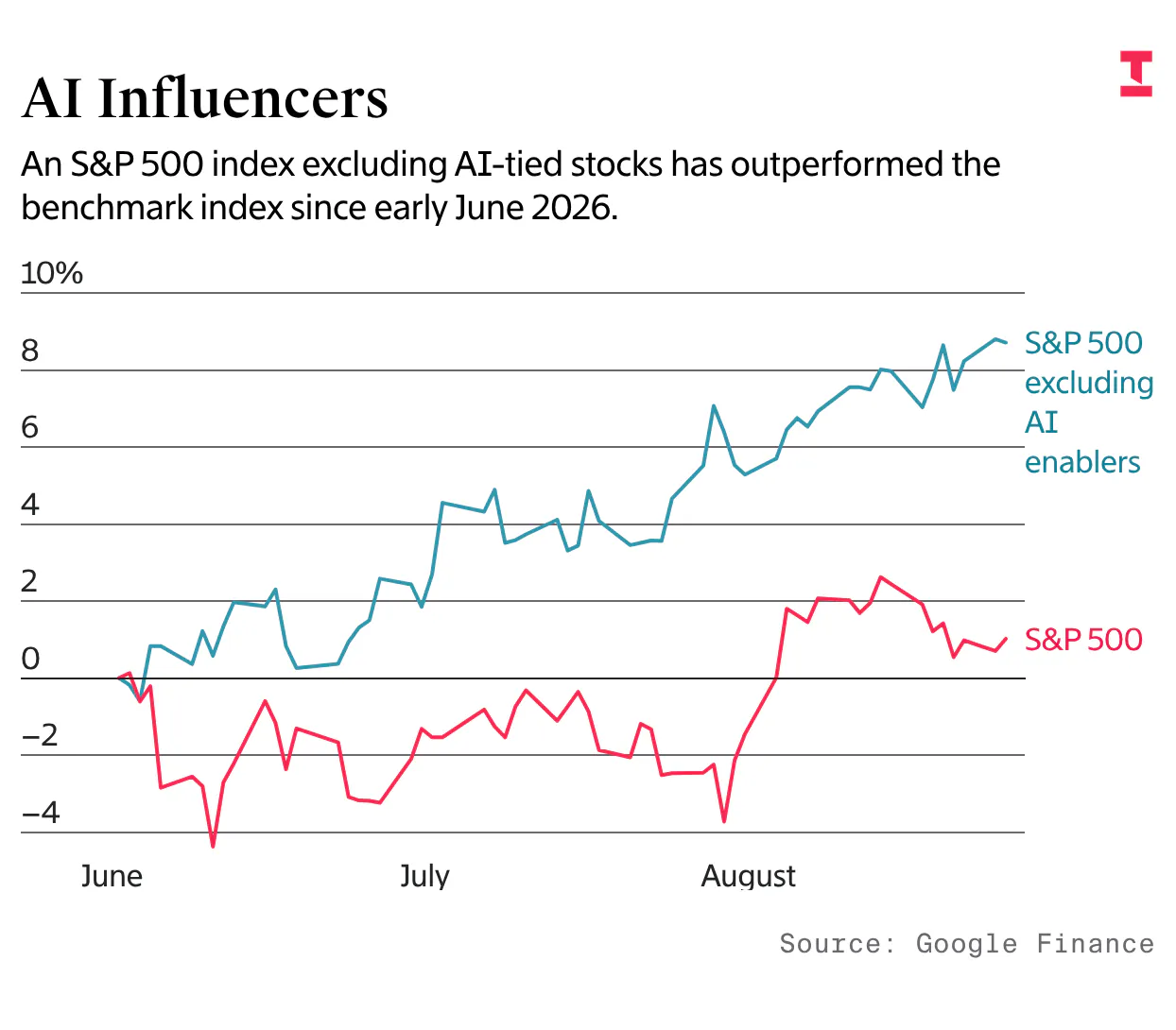
Investors have been hunting for anything but AI. That search has sent bursts of billions of dollars into typically ho-hum parts of the market like insurers and small-cap stocks, where they can have an outsize impact.
One place that trade is showing up is in an index Goldman Sachs launched in February that strips “AI enablers” out of the S&P 500. The bank’s index excludes companies with meaningful AI-related revenue, infrastructure or demand exposure, according to Goldman Sachs’ Equity Custom Basket desk. That means companies tied to data centers and power infrastructure, chips, networking and cloud computing are left out, though the lineup can change as companies’ exposure to AI evolves.
That index, called SPXXAI, lagged the regular S&P 500 performance earlier this year, but the script has flipped this summer. Since the start of June through Tuesday’s market close, the non-AI version is up 8.7%, while the regular S&P 500 has gained just 1%. To be sure, the S&P 500 still leads in gains since SPXXAI’s February launch overall, and the relative performance has been choppy during August.
The bank’s institutional clients can use the index as a way to develop strategies to hedge AI exposure amid volatility in the sector. You can see a public quote for the index showing its performance, though there isn’t a fund tracking it right now that everyday investors can buy. (Goldman does not publicly disclose the full list of stocks in the index.)
Taking AI out of the S&P 500 is just one way to look at things. Investors are also zeroing in on specific non-AI sectors—or going outside the S&P 500 entirely. In a mid-August note, Bank of America analysts said one of the most frequent questions they’re hearing from large investors is what stocks are “working” without relying on AI. They highlighted biotech stocks, insurers and regional banks, and indexes that weight small-cap companies based on their sales rather than market value.
Exchange-traded funds tracking those areas have returned roughly 9% or more since the start of June, while an AI-focused ETF is down 9%. While this is just a small snapshot in time, this outperformance persists even if you zoom out a bit. Year to date, biotech, small-cap and regional-bank ETFs are outperforming the S&P 500, though insurers are lagging.
It wasn’t that long ago that it was all the rage to try to be an AI company. Struggling shoe seller Allbirds famously agreed to sell its brand and footwear assets and then turned the remaining public company, now called Smartbird, into an AI infrastructure provider. It’s been easy to poke fun at the most extreme examples of companies trying to transform their businesses into AI ones.
Still, you couldn’t exactly blame them. For much of the past three years, companies outside megacap tech had watched investors pile into stocks at the center of the AI boom, sending share prices for a small group of giants soaring while much of the rest of the market got left behind.
But there was a real vibe shift this summer: Investors stepped up their hunt for returns outside the crowded AI trade while also growing more sensitive to the enormous spending and debt tied to the AI build-out. The S&P 500 is weighted by market value, so giant AI-linked companies like Nvidia, Microsoft, Amazon, Alphabet and Meta Platforms have an outsize influence on its performance.
And because AI giants are so enormous, even a small reallocation away from them can translate into a flood of buying across neglected corners of the market. To put things in perspective, Nvidia alone accounted for about as much of the S&P 500 as its energy, utilities and real estate sectors combined at the end of July.
We’ve seen some big shifts as investors rotate in and out of AI exposure, though the movements have been volatile. An iShares ETF tracking the Russell 2000 small-cap index saw about $2.3 billion in net inflows over five trading days in July, according to BlackRock data, followed by about the same in net outflows over the following days. That ETF has a heavy concentration in healthcare, financials and industrials, with its largest holdings including aircraft parts maker Moog, medical device maker Glaukos and Brinker International, owner of Chili’s and Maggiano’s.
It can be nice for low-profile companies to see waves of money coming to their sectors, but it’s also something the non-AI executives have little control over and can’t predict reliably. You can imagine a world in which executives chugging along in businesses like insurance or manufacturing get frustrated by just how little their management matters amid these shifts, when an entire sector may be moving in or out of favor. For example, broad rotations by investors out of AI into other areas might drown out company-specific news, like an individual earnings success or shortfall.
Cyclical factors have always had an impact on areas like industrial shares, while interest rates heavily influence financial and insurance stocks, though the AI trade is a new dynamic. That’s something for executives and boards to navigate when it comes to negotiating mergers and acquisitions prices and managing other things tied to a company’s share price.
At the same time, it’s tough for investors to fully avoid the impact of AI in many businesses. S&P 500 member Ford, for instance, has said it plans to invest roughly $2 billion to convert some battery-manufacturing capacity to make battery energy storage systems for data centers and utilities. Generac, which makes backup generators and is another member of the benchmark, is ramping up its production capacity amid surging data-center orders.
Regional banks haven’t entirely escaped the AI boom either, financing some data center construction and also lending to suppliers involved in the buildout. To be sure, the biggest AI financings are leaning on larger banks and large pools of private credit, as we’ve covered in depth. Meanwhile, insurers are increasingly helping to finance AI, buying up some of the longer-term debt funding the data center build-out.
We’ll see how the market reacts to Nvidia earnings on Wednesday—they’ll likely give investors fresh ammunition to revisit their AI bets either way.
New From Our Reporters


Filling In the Gaps in Nvidia’s $500 Billion Financing Pitch
By Dakin Campbell
More from The Information — AI
-
Musk Responds to The Information’s Report About SpaceX Setting Up a Turbine Blade Factory
Aug 30
-
Exclusive: SpaceX Lays Groundwork For Turbine-Blade Factory to Solve Data Center Power Crunch
Aug 29
-
The Hugging Face Hack’s Chilling Postmortem
Aug 29
-
Why ‘Tax Alpha’ Is Silicon Valley’s New Obsession
Aug 29
Discussion (0)
Sign in to join the discussion. Free account, 30 seconds — email code or GitHub.
Sign in →No comments yet. Sign in and be the first to say something.