REA Reverse – Engineer Anything
Mirrored from Hacker News — AI on Front Page for archival readability. Support the source by reading on the original site.
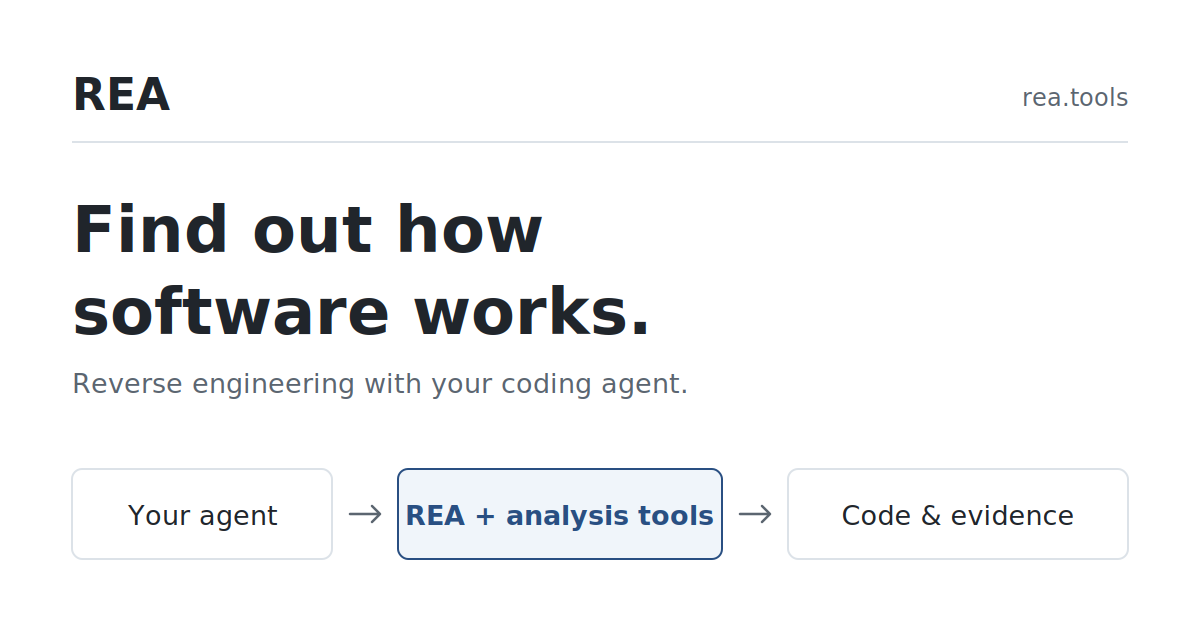
Reverse engineering, with your coding agent
Find out how
software works.
REA gives your agent the tools to inspect a program and explain what it does.
Already know RE? Skip to analysis guides →
Set up REA
Copy this into your coding agent:
›Install REA and connect it to this coding agent using npx rea-agents@latest setup. Show me the setup plan for approval, then verify the installation.
Or run this in your terminal:
npx rea-agents@latest setup
Approve the setup plan, then restart your agent.
What is reverse engineering?
Finding out how software works by examining the program itself.
The goal: understand a feature well enough to explain it, change it or rebuild it.
One question: why does Calculator give 220 for 200 + 10%?
Before REA · You investigate it yourself
0x180124945: MOV EAX, dword ptr [R13 + 0x18]
0x180124949: CMP EAX, 0x5c
0x18012494c: JZ 0x180124aba
0x180124952: CMP EAX, 0x5b
0x180124955: JZ 0x180124aba
0x18012495b: MOV EDX, 0x64
0x180124960: LEA RCX, [RSP + 0x160]
0x180124968: CALL 0x180122650
0x18012496e: LEA RDX, [R13 + 0x160]
0x180124975: LEA RCX, [RSP + 0x78]
0x18012497a: CALL 0x180109720
0x18012497f: MOV RSI, RAX
0x180124982: MOV qword ptr [RSP + 0x28], RAX
0x180124987: LEA RDX, [RSP + 0x160]
0x18012498f: MOV RCX, RAX
0x180124992: CALL 0x180123190
; … value-copy instructions omitted …
0x180124a14: MOV RDX, RDI
0x180124a17: LEA RCX, [RSP + 0xf8]
0x180124a1f: CALL 0x180109720
0x180124a24: LEA R8, [RSP + 0x30]
0x180124a29: MOV RDX, RAX
0x180124a2c: LEA RCX, [RSP + 0xb8]
0x180124a34: CALL 0x180123c10
You decode the instructions, follow the calls and reconstruct the calculation.
With REA · You ask your agent
One prompt.
Ask your agent in plain English.
›Use REA to inspect Windows Calculator. Why does 200 + 10% give 220?
Example answer · based on the findings
After +, the % button takes a percentage of the first number.
10% of 200 = 20↓200 + 20 = 220
Let's try two examples. Change a game's speed, then return to Calculator and rebuild its % button.
Example 01 · Chrome’s dinosaur game
Why does the dinosaur get faster?
Play the reconstruction
Original rule: start at 6, then increase toward 13.
Enable JavaScript to play the reconstruction. The code and explanation above remain readable.
REA returned
The script actually running in the page. The agent reads its update function and speed settings, then uses that rule in a new game.
›Use REA to inspect this dinosaur game. Why does it get faster? Show the speed rule, then build a small version with an adjustable speed.
Inspected target: wayou’s Chromium-derived browser edition.
if (this.currentSpeed < this.config.MAX_SPEED) {
  this.currentSpeed += this.config.ACCELERATION;
}
Start at 6. Add 0.001 each update without a collision, while speed is below 13.
Open the speed lab →What each part does
- 01 · REARead the running game’s scriptReturn its actual code and settings to the agent.
- 02 · Your agentRebuild the rule, add a controlUse the recovered acceleration in a small game with a speed slider.
- 03 · YouChange the speed and playTry the original acceleration, then choose your own pace.
REA inspected the HTTP browser edition through a local debugging
connection and returned the loaded index.js,
including its source and digest.
ACCELERATION: 0.001,
MAX_SPEED: 13,
SPEED: 6
We called the original game’s update function in a controlled browser check, with obstacles and automatic scheduling disabled. After 4,000 updates, speed was 10.0; after 10,000, it was 13.0, rounded to one decimal.
The new mini-game keeps that speed rule. Its drawing, jumping and collision code are a small teaching implementation. Open the lab to see the new code and run the same speed check.
To inspect the target yourself, follow the browser connection steps using the dinosaur page. Give your agent that page URL and your local debugging endpoint, then copy the prompt above.
Example 02 · Windows Calculator
Rebuild Calculator’s % button.
We saw why 200 + 10% gives 220. Now let’s recover the rules for both + and ×, and try them.
Try the calculation
10% of 200 = 20. Then 200 + 20 = 220.
REA returned
One branch divides by 100. The other also multiplies by the first number. The agent uses both to recreate the % button.
For this example, previous = 200 and
current = 10.
›Use REA to inspect Windows Calculator’s % button. Recover the rules after + and ×, then build a small calculator that uses both.
if (operation == multiply || operation == divide) {
  percent = current / 100;
} else {
  percent = current * previous / 100;
}10% of 200 = 20 → 200 + 20 = 220
200 × 0.1 = 20
From the installed app to a working % button
-
01 · REA reads calc.exeIt launches the Calculator appThe code opens
ms-calculator:. The agent then selects the installed app’s library. -
02 · REA reads the libraryReturn the % handler’s codeThe function checks the operator and uses the constant
100. - 03 · Your agent interprets itExplain and reproduce the rulesCrosscheck the branch with Microsoft’s source, then try + and × above.
0x180124945: MOV EAX, dword ptr [R13 + 0x18]
0x180124949: CMP EAX, 0x5c
0x18012494c: JZ 0x180124aba
0x180124952: CMP EAX, 0x5b
0x180124955: JZ 0x180124aba
0x18012495b: MOV EDX, 0x64#define IDC_MUL 92 // 0x5c
#define IDC_DIV 91 // 0x5b
#define IDC_PERCENT 118 // 0x76
0x64 = 100Inspected with REA 4.1.0: Windows Calculator 11.2508.4.0, x64. The readable summary uses names from Microsoft’s public source to explain the recovered branch.
Percentage implementation · Microsoft’s test cases · Native setup guide
Your first investigation
Try REA on a small app.
Download our Notes example, trace its CSV export, and check one changed input.
Want to go deeper?
Tell your agent what you want to understand or build. With REA, you can work together on anything from cloning this website to reconstructing a game from its executable.
›Use REA to inspect https://rea.tools/. Clone this website for me.
Yes, this one.
›Use REA to reconstruct this game from its executable. Recover the gameplay logic in C and test it against the original.
For setup and analysis steps, choose your target:
Native binaries
Inspect functions, strings, references and call relationships in executables and libraries.
Native analysis guideJavaScript & Electron
Map modules, routes, IPC and native dependencies from an application folder or ASAR archive.
Application workflowsBrowser & runtime activity
Capture selected browser or process activity, then compare the results across runs.
Browser observation guideAny questions?
Read the FAQ, chat with us on Discord, or open a GitHub issue for bugs and feature requests.
Discussion (0)
Sign in to join the discussion. Free account, 30 seconds — email code or GitHub.
Sign in →No comments yet. Sign in and be the first to say something.