Memory prices climb 500% in 12 months
Mirrored from Hacker News — AI on Front Page for archival readability. Support the source by reading on the original site.
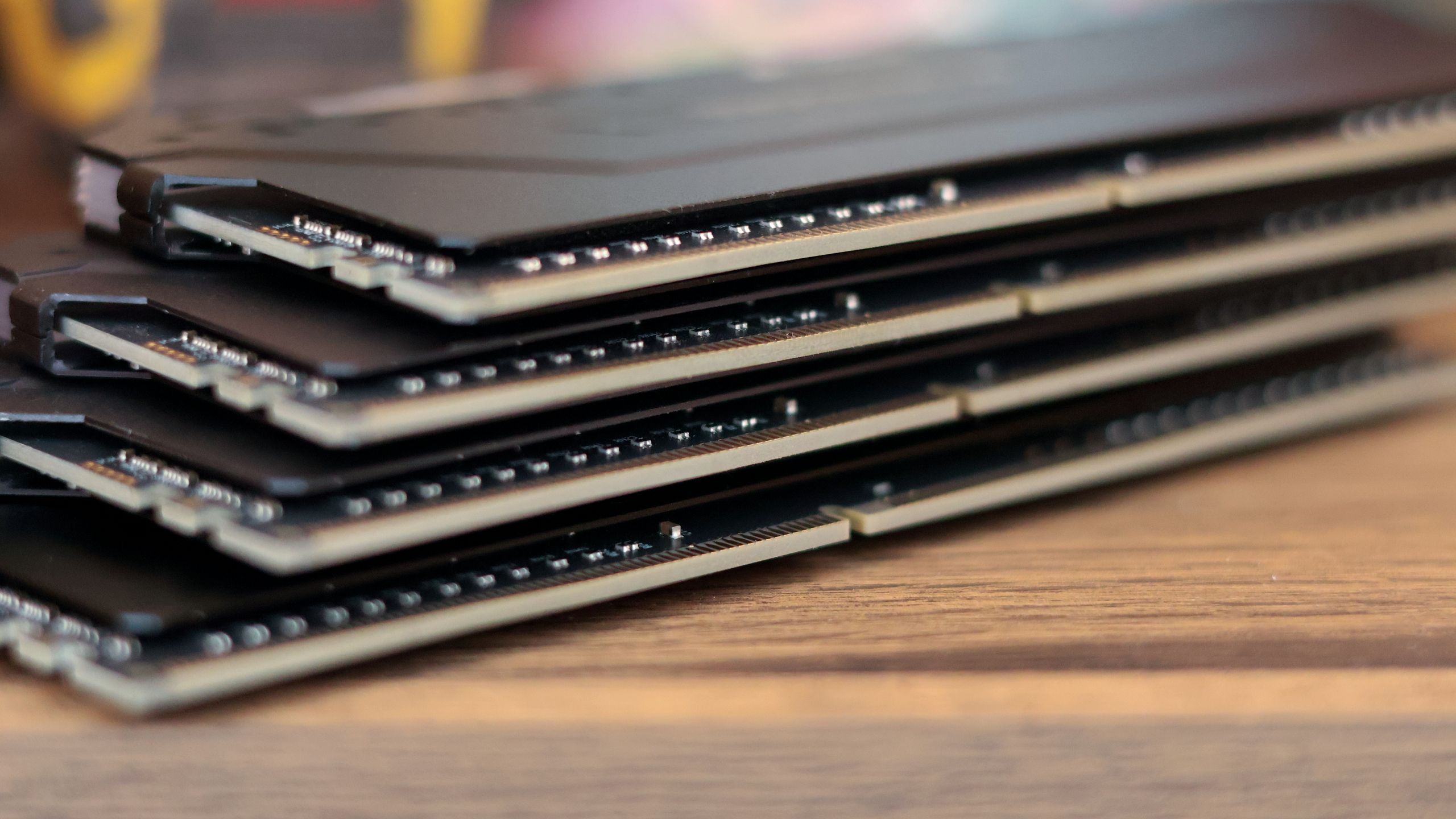
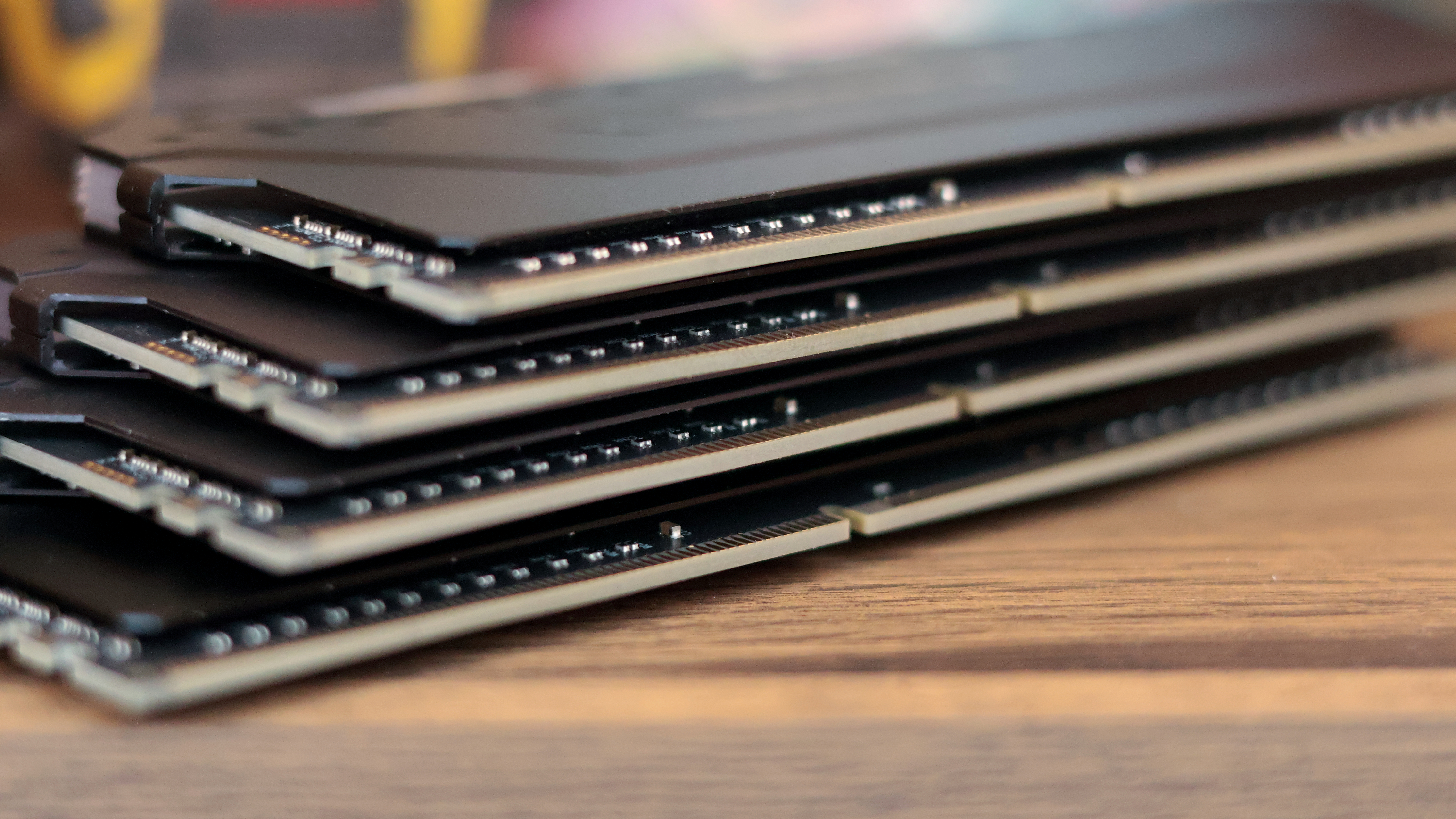
We're officially in dire straits. There's almost no way, if you're reading this site, that you aren't aware that memory prices have become entirely divorced from reality. Some are calling it the RAMpocalypse; I prefer "RAMageddon." Whatever you want to call it, though, the reality for PC builders right now is just grim. To put this in perspective, just take a look at our RAM price tracking post:
Memory Kit |
Best U.S. Price |
Lowest-Ever U.S. Price |
DDR5-5200 16GB |
$52 |
|
DDR5-5600 16GB |
$199 |
|
DDR5-5600 32GB |
$72 |
|
DDR5-6000 16GB |
$197 |
|
DDR5-6000 32GB |
$72 |
|
DDR5-6000 48GB |
$144 |
|
DDR5-6000 64GB |
$159 |
|
DDR5-6000 96GB |
$189 |
|
DDR5-6400 128GB |
$329 |
|
DDR5-6600 32GB |
$158 |
That's right: 128GB DDR5 kits are fully ten times more expensive than the lowest price we've ever seen. Things improve as you step down the memory capacities and speed tiers, but not as much as we'd like. You're still looking at $392 for a memory kit that was just $72 last year.
To reinforce the point, I pulled the latest average price data from PCPartPicker, comparing where we are today (August 2026) to exactly one year ago. This data is somewhat approximate, but it should be broadly accurate.
Memory Kit Speed & Size |
August 2025 Average Price |
August 2026 Average Price |
Change (YoY) |
|---|---|---|---|
4800 MT/s 2×16GB |
$90 |
$425 |
+$335 |
5200 MT/s 2×16GB |
$100 |
$480 |
+$380 |
5600 MT/s 2×16GB |
$116 |
$528 |
+$412 |
6000 MT/s 2×16GB |
$108 |
$572 |
+$463 |
5600 MT/s 2×32GB |
$191 |
$1118 |
+$927 |
6000 MT/s 2×32GB |
$222 |
$1272 |
+$1050 |
The numbers speak for themselves; in just 12 months, the cost of DDR5 memory has essentially exploded. We are looking at year-over-year increases nearing 500% for high-capacity kits. A standard 64GB (2x32GB) DDR5-5600 kit that would have cost you under $200 last summer is now demanding over $1,100. It is a 5x multiplier on a component that used to be a fairly boring and predictable line item in a PC build budget.
Memory Kit Speed & Size |
August 2025 Average Price |
August 2026 Average Price |
Change (YoY) |
|---|---|---|---|
3200 MT/s 2×8GB |
$63 |
$163 |
+$100 |
3600 MT/s 2×8GB |
$75 |
$165 |
+$90 |
3200 MT/s 2×16GB |
$105 |
$281 |
+$176 |
3600 MT/s 2×16GB |
$120 |
$307 |
+$187 |
3200 MT/s 2×32GB |
$222 |
$614 |
+$392 |
3600 MT/s 2×32GB |
$300 |
$789 |
+$489 |
If you plan to just wait it out on an older AM4 or LGA1700 motherboard with DDR4, you'd better hope your memory holds out too, because DDR4 isn't safe from the fallout. With DDR5 entirely out of reach for most builders, the resulting scramble for older platforms running DDR4 memory has created a massive knock-on effect, and as a result, DDR4 kits are up anywhere from 120% to nearly 180% across the board. Nowhere near as bad as DDR5 pricing, but it still stings when a kit that was $105 last year is $281 this year.
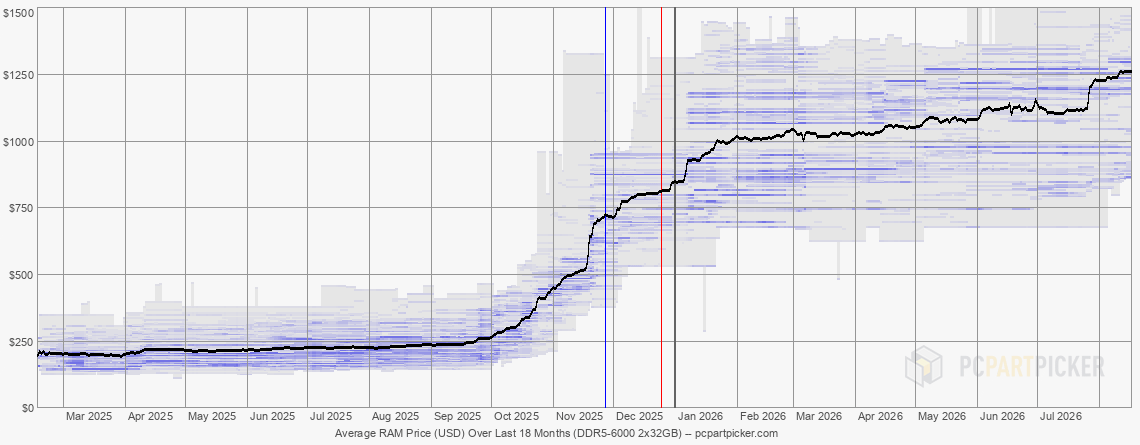
This phenomenon is by no means exclusive to the US, either. German tech site ComputerBase have also been tracking this global trend, reporting just this week that average RAM prices in Europe have skyrocketed by 345% compared to September 2025. Their data shows the squeeze is bleeding into other components too, with hard drive and SSD prices both climbing over 125% in that same timeframe.
In fact, the situation is so severe that hyperscale buyers have reportedly already locked in almost all of the global DRAM production capacity for 2027, handing over advance deposits to guarantee their supply of precious DRAM, which is now among the highest-value commodities in the world by weight; mainstream DRAM chips are worth over half as much per kilogram as solid gold. PC and smartphone makers are simply fighting over the scraps, as low-priority markets compared to the extremely lucrative AI datacenter buildouts. And lucrative they are indeed; all four memory vendors (SK hynix, Samsung, Micron, and China's CXMT) have increased revenues by double, triple, or even more, all in just the space of one year.
Get Tom's Hardware's best news and in-depth reviews, straight to your inbox.
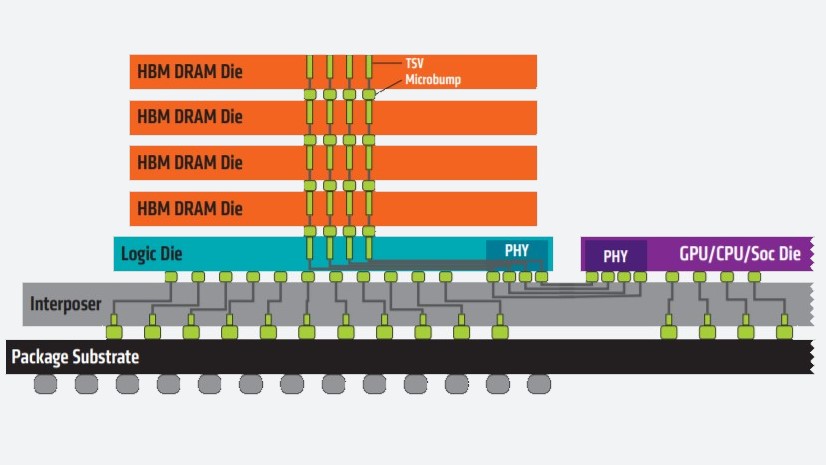
For consumer prices to drop, we would essentially need a major contraction in the AI market, which would mean a massive correction in financial markets worldwide. Absent that, the people actually making the chips don't see an end in sight. SK Hynix CEO Kwak Noh-jung recently warned that 2027 will be the worst year for memory supply in the industry's history, forecasting that demand will outstrip their ability to produce it well into 2030. ADATA's Chairman, Simon Chen, was even more pessimistic, suggesting this DRAM crisis could last another 10 years and dismissing the idea of an "AI bubble" bursting anytime soon.
The era of cheap, plentiful memory is over, at least for now. If you need RAM today, you're either going to have to bite the bullet and pay the premium, or learn to get by with less. Make sure you check out our RAM price tracking post for the best deals we found on memory, as well as some tips on how to secure solid deals yourself.

Follow Tom's Hardware on Google News, or add us as a preferred source, to get our latest news, analysis, & reviews in your feeds.

Zak is a freelance contributor to Tom's Hardware with decades of PC benchmarking experience who has also written for HotHardware and The Tech Report. A modern-day Renaissance man, he may not be an expert on anything, but he knows just a little about nearly everything.
-
Very glad I upgraded to AM5 about 6 months ago. That said, direct RAM prices aren't really the worst part. Every single GPU and every video game console and so forth are all badly affected by this as well. It's a significant overall inflation on many digital products.Reply
-
Financial greed knows no limits. :angry:Reply
-
A few years ago when there was a used car shortage, I could have sold my then 5-year old vehicle for more than I bought it for new, defying normal depreciation expectations. That didn't last long-term, and this won't either, because it can't.Reply
To some extent, it is just the market at work, doing what it's supposed to do - in times of demand severely outpacing supply, high prices help to ensure it's at least still possible to get what you need if you really need it - even if it's essentially being highly discouraged - and also for the longer-term, the profit potential encourages increasing supply.
But for anyone who doesn't absolutely have to upgrade/replace memory now/in the next couple years, it makes sense to wait. I think it will probably be 2029/2030 before I think about buying any more hardware, unless the AI bubble bursts and things rapidly change before then.
For games - and software in general - this is also something developers need to be thinking about when making projections about what hardware customers are likely to have, and the associated tradeoffs - because there's always sort of a balance to strike between quantity of features and optimization/runtime efficiency, and also what kinds of features are worth building into the product. -
In 3 years when all this used equipment hits the secondary markets prices will crater.Reply
-
Reply
This is not "greed" this is supply vs demand in action.TechieTwo said:Financial greed knows no limits. :angry:
Just curious, if you call this "greed," then what did you call the low point? -
Enterprise SSDs I paid $100 for in Oct 2025 are now $433Reply
256GB ECC memory I paid $400 for in Oct 2025 now cost $1,600. -
Replyinverse137 said:This is not "greed" this is supply vs demand in action.
Just curious, if you call this "greed," then what did you call the low point?
If the memory makers hadn't increased prices, it would be much worse today - it would be another one of those cases where scalpers buy up most of the product readily available. And anyone else who gets the opportunity to do so at MSRP would buy the maximum amount possible - even more than they would have purchased normally/without the shortage - just because they don't know if they'd get the chance to do so again at a reasonable price later.
So the vast majority of people who needed memory for a new system - if they could get it at all - would be forced into buying from a seller of questionable repute on Ebay, facing the possibility of getting scammed, and having to wonder if they'd be able to get warranty coverage. While the high prices are unwelcome, I'd still rather see high retail prices from reputable sellers than deal with that. -
Reply
I've found it easy to get good used memory on ebay. Ignore sellers with low ratings or near zero sales, ignore China.timsSOFTWARE said:forced into buying from a seller of questionable repute on Ebay, facing the possibility of getting scammed, and having to wonder if they'd be able to get warranty coverage.
There are sellers with thousands or tens of thousands of sales and 99-100% rating.
I get no warranty beyond maybe 30 days, but it seems the value of those is questionable these days. -
The saddest thing is there's someone who's getting ready to build a brand new PC anyway in some pseudo attempt to "stick it to the man" Yeah Im gonna drop $1000 on two sticks of ram, that'll learn em!!!!!Reply
-
Reply
That doesn't sound like a common scenario. Which is why sales are dropping.teeejay94 said:The saddest thing is there's someone who's getting ready to build a brand new PC anyway in some pseudo attempt to "stick it to the man" Yeah Im gonna drop $1000 on two sticks of ram, that'll learn em!!!!!
A sad thing is that people who need CPU performance (for real work) will have to bite the bullet and pay the DDR5 premium.
For example, a Ryzen 9 9950X is around 40-45% faster (TechPowerUp, PassMark) than a Ryzen 9 5950X. 24-core Zen 6 could be around 150% faster than a Ryzen 9 5950X. Even if you have to pay $900 on a 64 GB kit, it could be worth it.
Discussion (0)
Sign in to join the discussion. Free account, 30 seconds — email code or GitHub.
Sign in →No comments yet. Sign in and be the first to say something.